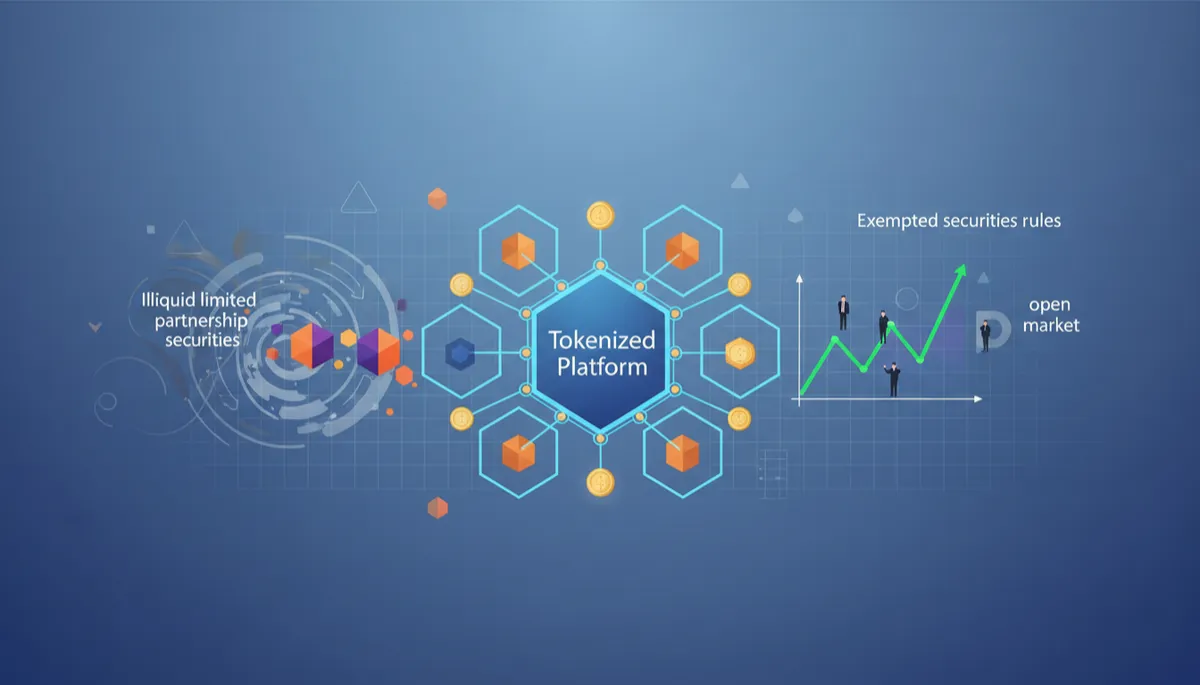
Tokenizing Limited Partnership Interests
Capital Markets, Tokenization, Private Funds
Bringing Illiquid Limited Partnership Interests to an Open, Tokenized Market
A new generation of market infrastructure is emerging that lets investors trade traditionally illiquid limited partnership interests on an open market, supported by tokenization while still operating under familiar exempt securities rules.
From Locked-Up Capital to Tradable Limited Partnership Interests
Limited partnership (LP) interests in private equity, venture capital, real estate and infrastructure funds have traditionally been notoriously illiquid. Investors commit capital for years, often with only a narrow window for transfers via negotiated secondary sales. Pricing is opaque, settlement is slow and operational friction is high.
Introducing an open market for these LP interests does not mean turning them into fully public securities. Instead, it means creating a structured venue where qualified buyers and sellers can meet, discover prices and transact within a clearly defined rule set that respects the underlying partnership agreements and investor protections.
The Role of a Tokenized Trading Platform
The enabler of this open market is a tokenized platform that represents each LP interest, or fraction thereof, as a compliant digital token. These tokens are not cryptocurrencies in the speculative sense; they are digital wrappers around real-world exempt securities, embedding ownership rights, transfer restrictions and investor eligibility rules directly into the technology layer.
On such a platform, every trade can be:
Programmatically checked for compliance with offering documents and regulatory constraints
Recorded immutably on a distributed ledger, enhancing auditability and investor confidence
Settled faster than traditional secondary transfers, reducing counterparty and operational risk
Digitized LP units and automated checks make secondary trading faster, cleaner and more transparent.
Operating Within Traditional Exempt Securities Rules
Crucially, this innovation does not require abandoning the established framework for exempt securities. The same exemptions that govern private fund offerings today—such as sales to accredited or professional investors, transfer restrictions and holding periods—continue to apply. The difference is that these rules are enforced by design within the platform.
Investor onboarding, know-your-customer (KYC) and suitability checks are completed before any token is issued or traded. Transfer controls can prevent tokens from moving to ineligible investors or jurisdictions. In effect, the platform becomes a gated open market: accessible to a broad universe of qualified participants, but still fully aligned with the spirit and letter of exempt offering regulations.
What This Means for Professional Investors and Fund Managers
For institutional and professional investors, an open, tokenized market for LP interests offers greater flexibility in portfolio construction and risk management. Allocations that once required a decade-long commitment can be adjusted more dynamically, subject to fund terms and regulatory constraints. For fund managers, a controlled secondary venue can enhance the attractiveness of their products without compromising long-term investment strategies.
Ultimately, the convergence of tokenization, an open yet gated marketplace, and traditional exempt securities rules points toward a more efficient, transparent and investor-friendly private markets ecosystem—one where illiquidity is a choice, not an inevitability.
